


The Emotional Healing Process: Where to Begin When Your Heart Feels Heavy
Some seasons do not just feel hard. They feel heavy.
You keep showing up and doing what needs to be done. You may even be praying, reading your Bible, and trying to stay positive. But underneath it all, something still feels off.
Your chest feels tight, and your thoughts are loud. Or maybe it is the opposite. You feel flat, tired, or disconnected from yourself and from God. You wonder why you cannot just bounce back, move on, or feel better by now.
These are difficult emotions, and they can leave you feeling confused, discouraged, or emotionally worn down. But here is the good news: you do not have to shame yourself for what you feel, and you do not have to rush your way out of pain to begin healing. Emotional healing often starts with learning how to notice what is happening inside you, bring it into the light, and respond with honesty, compassion, and God’s help.If you are longing for emotional healing, the first step may be gentler and more practical than you think.
What Is Emotional Healing, Really?
Healing emotionally is not about becoming someone who never feels sad, anxious, angry, or overwhelmed.
It is not pretending everything is fine when it is not, or forcing yourself to “have more faith” so you can skip over pain. And it is not a quick fix that makes every hard feeling disappear overnight.
Emotional healing is the process of becoming more aware of your inner world and learning how to care for it with truth, compassion, and God’s presence. It is what happens when you stop running from your emotions, stop shaming yourself for having them, and begin to listen to what they may be revealing about your needs, your hurts, and your heart.
Over time, emotional healing helps you become more grounded. You may still feel hard things, but those feelings no longer have to control you or define you. Instead of stuffing them, fearing them, or getting swept away by them, you begin to walk through them in a healthier, more honest way.
That is especially important if you have spent a long time trying to look okay on the outside while quietly feeling overwhelmed within.
Soul Care Check-In: What Is Quietly Draining Your Peace?
If you are not sure what has been weighing on your heart or keeping you stuck in overwhelm, you do not have to guess.
Take my free quiz, “What’s Blocking Your Abundant Life?”, and get insight into which patterns may be quietly affecting your emotional well-being in this season:
Why the Emotional Healing Process Can Feel So Slow
One of the hardest parts of healing emotionally is that it often feels slower than we want it to.
You may pray about the same struggle more than once. You may think you have worked through something, only to have it resurface again later. You may even wonder if you are doing something wrong because you are still feeling tender, triggered, or tired.
But slow does not mean stuck.
Sometimes healing feels slow because your heart and nervous system have been carrying too much for too long. Maybe you learned early on to ignore your feelings, push through pain, or stay busy so you would not have to deal with what was really going on inside. Maybe you have not had the words for your emotions, or maybe no one ever taught you that your feelings were worth paying attention to in the first place.
When that is your starting point, emotional healing is not just about “feeling better.” It is about learning safety and that you can slow down, notice what is happening inside, and stay present with yourself and with God in the middle of it.
That kind of healing takes time, and that is okay.
5 Gentle Steps in the Emotional Healing Process
1. Notice what you are feeling without judging it
The emotional healing process often begins with a pause.
Not a huge breakthrough. Not a perfect prayer. Just a pause long enough to notice what is happening inside you.
Whatever is there, the goal is not to judge it or fix it immediately. The goal is simply to acknowledge it.
You might say to yourself:
- “Something feels heavy right now.”
- “I can tell I am not okay.”
- “I feel off, and I want to pay attention instead of pushing past it.”
That kind of noticing is not weakness; i is wisdom. You cannot care for what you will not allow yourself to see.
2. Name the emotion as clearly as you can
Once you notice that something is going on, the next step is to put words to it.
This can be harder than it sounds. Many women can tell when something feels “off,” but struggle to identify what they are actually feeling. That is okay. You do not need perfect language. Start simple.
Maybe the feeling is:
- sadness
- fear
- disappointment
- grief
- resentment
- shame
- numbness
Naming your emotions helps bring clarity. It helps you move from vague overwhelm into something more specific and more workable. And often, once you can name what you are feeling, you are better able to understand what your heart needs next.
If naming emotions feels especially difficult for you, that may be a sign that your inner world has gone unattended for a long time. That does not mean you are bad at healing. It just means this is a place to begin gently.
Need a Gentle Next Step for Difficult Emotions?
If you want guided support in learning how to pause, name what you feel, and respond with more peace and clarity, my mini course Navigating Difficult Emotions was created for exactly that kind of moment.
It is a simple, faith-centered resource to help you move through hard emotions with more compassion, steadiness, and support.Discover Navigating Difficult Emotions here.
3. Respond to yourself with compassion instead of criticism
For many women, the moment a difficult emotion shows up, the inner critic is not far behind.
It may sound like:
- “You should be over this by now.”
- “Why are you so emotional?”
- “What is wrong with you?”
- “You are being too sensitive.”
That kind of harsh self-talk does not lead to healing. It usually leads to more shame, more shutdown, and more distance from what is actually going on.
Emotional healing grows when you learn to respond to yourself with compassion instead.
Self-compassion does not mean excusing unhealthy behavior or ignoring the truth. It means recognizing that you are in a hard moment and choosing to meet yourself with kindness rather than cruelty.
It sounds more like:
- “This is painful right now.”
- “Of course, I am struggling. I have been carrying a lot.”
- “I need care, not shame.”
- “God, help me be gentle with myself in this moment.”
Compassion creates space to be honest. And honesty is where healing begins.
4. Bring your real emotions to God in prayer
One of the most healing things you can do is bring your emotions to God as they actually are, not as you think they should be.
You do not need polished words. You do not need to clean up your feelings before you pray. God is not intimidated by grief, anger, fear, confusion, or numbness. He already sees it all, and He welcomes your honesty.
The Psalms give us language for this. Again and again, we see people bringing their real pain, questions, and cries to God. They do not pretend. They pray from the middle of their experience.
You can do the same.
You might pray:
- “Lord, this is what I am feeling.”
- “God, I do not even have words, but I need You here.”
- “Help me understand what is happening inside me.”
- “Meet me here with Your peace and truth.”
Prayer does not always remove pain immediately. But it does remind you that you are not carrying it alone.
5. Receive support from safe people
Emotional healing is personal, but it is not always meant to be solitary.
Sometimes we need another safe, grounded person to help us untangle what we are feeling. A trusted friend, counselor, coach, or mentor can offer perspective, compassion, and support when we are too close to our own pain to see clearly.
There is something powerful about having your pain witnessed without being dismissed or rushed. Healing deepens when you are met with care.
You were never meant to carry:
- every emotion
- every disappointment
- every disappointment
- every burden
in isolation.
What Emotional Healing with God Can Look Like in Everyday Life
Emotional healing does not always look dramatic from the outside.
Sometimes it looks like:
- pausing before you react
- realizing sooner that you are overwhelmed and need rest
- being able to say, “I feel hurt,” instead of lashing out or shutting down
- praying more honestly
- feeling a little less shame and a little more clarity
- noticing your needs before burnout hits
That may not sound flashy, but it is real growth.
As emotional healing takes root, you may notice that you are:
- more present in your relationships
- more aware of your needs
- less afraid of your emotions
- more connected to God in the middle of your real life, not just after everything has settled down
This is often how emotional healing happens. Quietly. Steadily. One honest step at a time.
Ready for Gentle Support?
If you are tired of feeling hijacked by your emotions, shutting down when life feels heavy, or wondering why you still feel so overwhelmed even when you are trying to do all the “right” things, I created a resource to walk with you.
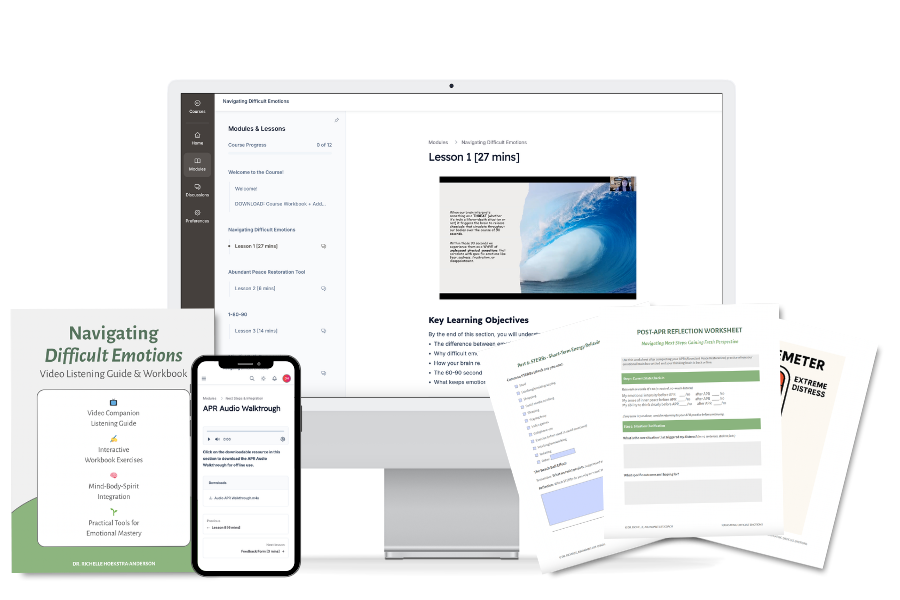
My mini course, Navigating Difficult Emotions, is a simple, faith-centered guide to help you:
- recognize what is happening in your brain, body, and heart when difficult emotions rise
- learn a gentle, practical process for noticing, naming, and responding to emotions with more compassion and clarity
- begin moving through anxiety, grief, overwhelm, or numbness with God instead of feeling like you have to power through on your own
It is a short, no-fluff roadmap you can return to anytime your emotions feel loud, confusing, or far away and you need a steady, grace-filled next step.
Inside, I walk you through the Abundant Peace Restoration (APR) process and give you practical support through:
- short video lessons
- a listening guide and workbook
- a guided audio you can use in real time when emotions begin to take over
If your heart is longing for emotional healing and you want a gentle place to begin, this is a beautiful next step.
Start Navigating Difficult Emotions today:
drrichelle.com/navigating-difficult-emotions
Seeking Support? Let’s Connect.
You were not created to live weighed down by unprocessed pain, constant emotional pressure, or the belief that you have to hold it all together on your own. As you begin the emotional healing process, may you discover more clarity about what you are feeling, more compassion for what your heart has been carrying, and a deeper experience of the peace and abundant life Christ has already offered you.
I’m Dr. Richelle, and I help women heal, grow, and live with more peace, confidence and purpose in every season of life. For guidance on your path to an abundant life, schedule a complimentary call with me.
Join Abundant Soul Care with Dr. Richelle
If you’re longing for a quieter, more grounded way to care for your soul, I’d love to welcome you into the free community, Abundant Soul Care with Dr. Richelle.
It’s a faith-centered space for encouragement, honest conversation, and gentle guidance as you learn to live with greater peace, clarity, and intention—without pressure or perfection.
You don’t have to do this alone. You’re welcome here.
March 17, 2026
BY DR. RICHELLE HOEKSTRA-ANDERSON
Dr. Richelle Hoekstra-Anderson is an Abundant Life Coach. Her coaching utilizes a variety of tools to help you gain clarity on how you are designed for significance. When you come to understand and appreciate your unique design, you create the mindset to help you meet current challenges and live an abundant life. Ultimately, you gain new insight and learn the skills needed to create a confident life of peace, balance, and joy.
ABOUT THE AUTHOR

TAKE THE QUIZ
Take this 5-question quiz to find out where you are and get a clear first step to move forward with confidence and faith.
Wondering where you are on the journey?
START HERE


